Alison’s story
Alison’s story of volunteering: “It’s really about building relationships, we’re like a big supportive family.”
Alison’s amazing volunteering support for the Hospice began when she, her husband Les, and their family, received ‘amazing’ care during the last few weeks of Les’s life:
“Les wanted to stay at home, so we had a home nurse and an occupational therapist who were brilliant. But when he got more poorly, he had to go into the Hospice for two weeks. The care was amazing – they looked after me, my kids, the whole family.”
Like many volunteers, Alison wanted to give something back for the support she’d received, so started a volunteering role collecting donation tins and helping at events, which allowed her to stay connected with others and help her through some difficult times:
“At first, I helped at events like the London Marathon, standing at the Cheer Station and meeting and greeting the runners. Then I helped the Fundraising team in the office, doing research, stock taking and general admin.”
Alison would recommend volunteering and feels that the training she received helped her experience: “There’s generic training for working at the Hospice, but also specific training for your role. I’ve always felt respected and valued for what I do.”
 Now Alison looks forward to her weekly shift as a shop volunteer in Staines, which she says helps provide a focus outside of her own life: “It gives me a huge sense of purpose. I enjoy meeting new people, giving something back, not only to the customers but the shop team too.”
Whether it’s sorting through stock, creating a beautiful window display, or chatting to a customer who has come to donate items of their loved one, Alison enjoys working as a team: “It’s really about building relationships, we’re like a big supportive family.”
As well as being out in the community, Alison also helped create many new bonds at the Hospice with her beloved late dog, Millie, who attended as a Pets as Therapy dog: “She loved meeting the patients, families and being made a fuss of,” says Alison.
It’s this ongoing passion, dedication (and also years of experience as a teacher), that led to Alison being asked to become an Ambassador for the hospice, a role which includes the opportunity to spread the word about the service and care the Hospice provides, which Alison enjoys drawing from her own experience for.
Ten years on, Alison is due to be awarded a 10-year Volunteer Long Service Award from the Hospice, a small token of appreciation for the incredible contribution she’s made as a volunteer.
Alison told us how it’s really changed her life, providing new opportunities and friendships: “I meet lots of new people. In fact, I met my two best friends through volunteering. It’s been a win-win situation for me. It’s so rewarding and whatever your skills, there will be a role for you.”
Andy’s story
‘’Princess Alice Hospice gave us an extra 15 months’’
While receiving treatment for leukemia at Kingston Hospital in 2012, Andy met a kind nurse in A&E called Hayley. Three years later, in late 2015, Andy’s wife, Louise was admitted to Princess Alice Hospice and was glad to see Hayley, who was, by then, working on the In-Patient Unit at the Hospice. Sadly, Louise had been diagnosed with stage 4 lung cancer and the district nurse did not expect her to return home from the Hospice. But, after two weeks of care and pain management, Andy recalls how ‘Louise left her room, walked to the car, we drove home and she walked into the living room. Princess Alice Hospice gave us an extra 15 months.’
Once back home, Andy started to take Louise to the Princess Alice Day Hospice (latterly the Wellbeing Centre) each week: ‘Louise loved to talk, I’d use the time to wash her bedding, do a food shop and then go and collect her. She really loved the nurses – Sharon, Branca, Mary and Kim.’ Louise felt safe in the Hospice and when she became self-conscious of how steroids had altered her appearance, she always felt comfortable coming to the Hospice café; she found that nobody stared at her and she could chat comfortably to the nurses she knew. Today, Andy and his sons, the ‘Wilson team’, continue to look at it as being a safe space, as did Louise.
During this time, Andy was advocating for Louise in various healthcare settings. He found that just by saying ‘Princess Alice Hospice said…’ he didn’t need to go against his nature and be ‘pushy’, but that staff would listen and Louise would receive what she needed.
By November 2015, Louise’s health had deteriorated and she was re-admitted to Princess Alice Hospice for a week of pain management. In February 2016, Louise received the devastating news at a hospital appointment that there were no more treatment options available and was advised to make the most of the remaining time she had left. She had told Andy that she would prefer to die at Princess Alice Hospice, because she knew her family would be looked after, too. Louise was taken by ambulance to Princess Alice Hospice on Saturday 18 June and died peacefully at 7.56am on Monday 20 June 2016. Andy and the couple’s three sons, then aged 26, 23 and 21yrs, were with her.
At 2pm that same day, The Shed was opened officially in the Hospice gardens. Nurse Cathy from the Day Hospice had invited Andy and his sons to attend a few weeks earlier, and four weeks later they arrived for their first session as ‘Shedders’. Andy says: ‘Cathy knew we needed it. Talking about feelings was something we’d never do.’ Andy and his sons continued attending weekly sessions at The Shed and gradually found themselves starting to talk about things.
Andy remembers how his eldest son hadn’t cried when Louise died, or cried at her funeral. A few weeks later, having told Andy, ‘I’m not doing so well’, he was told by his GP that a referral would take about 18 months to begin counselling. Andy spoke to Cathy and his son began bereavement counselling at Princess Alice Hospice the following week. After the first session, Andy remembers collecting him with ‘big red eyes’ and sitting in silence as they drove home. By week five, Andy’s son didn’t cry and said in the car afterwards, ‘I think next week will be my last.’
Andy also received bereavement counselling, which Louise had discussed with Steve Nolan, Spiritual Care Lead at the Hospice, before she died. Louise found her conversations with Steve gave her the ability to prepare positively for her own death. This included a visit to Lodge Brothers funeral directors to plan her own funeral, and a chat with her local vicar to discuss arrangements.
After attending The Shed sessions for several months, session leaders Miles and Ken asked Andy if he was planning to return to his role as IT Operations Manager at Harrods. The company had been good to him during bouts of serious illness, but Andy couldn’t find a reason to continue working purely for money, and decided to retire early. At this point, Miles offered to train him up as a Shed session leader and he took on the role in 2017.
As a session leader, Andy began attending events, fetes and fairs, connecting with the local community: ‘by then, I was comfortable sharing my story and I was happy to share my experiences to help others understand what Hospice care is.’
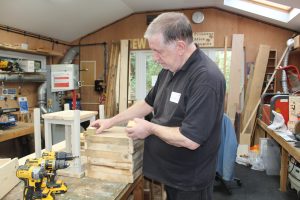 Today, Andy is proud of meaningful connections he’s made with Shedders over the years, and one stands out to him, in particular. After his wife died, the gentleman had started to drinking heavily. At one session, he told Andy that he respected the Shed was run by volunteers and understood that no one is allowed to attend if they have consumed alcohol, so he would not come if he had been drinking. Andy agreed to this. One day, Andy said, ‘you’ve been coming here every week for the past 3 months,’ and the gentleman replied, ‘after a few weeks of coming here, I realised my wife wouldn’t want me to drink myself to death. I’ve stopped drinking, but I won’t be able to come to the sessions anymore, I’ve got a new job as a DIY man at an old people’s home.’
Another Shedder told Andy that he didn’t know if he wanted to come, or needed to come, but he found the weekly sessions so helpful as he came to terms with the lack of time he’d spent with his wife after a successful career travelling the world over the years.
One lady became a Shedder after attending a community Walk and Talk and was delighted when she was able to make a bird box for her Dad’s 90th Birthday present. At the next Walk and Talk, she encouraged a fellow walker to join as a Shedder and he is now enjoying weekly sessions on a Wednesday.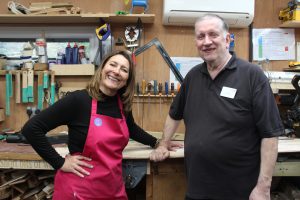
Andy feels that his own health issues have helped him connect with others, too: ‘I know how it feels when you’re facing death. The Hospice gave Louise a positive view about dying, it didn’t feel scary and made it easier to cope with.’
Local companies such as Perspex Distribution in Brooklands, Weybridge, kindly donate supplies for projects. In 2017, Alsford Timber’s managing director visited The Shed and said, ‘you’ve got a lot of toot but you haven’t got anything decent, just let me know what you need.’ The local company has supported The Shed with generous donations of wood ever since.
Andy remains grateful for the many connections he has with the Hospice, which continue today: ‘Princess Alice Hospice know what they’re doing, I can give them my time and pay it forward. It was always a safe space for me to be.’
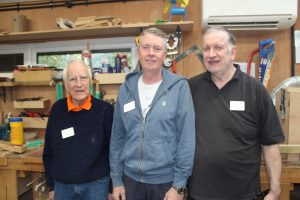 Andy is particularly proud that The Shed creates a safe space for people to connect in a way that works best for them: ‘we’ve had a group of mums attending via Dovetail (the Hospice’s children’s bereavement group). Sometimes somebody will cry and they’ll sit with each other the whole time, other times they’ll be busy working on projects.’
Andy feels it’s crucial that everybody knows they are welcome to The Shed: ‘we don’t judge anybody. Nobody runs The Shed, it runs itself. We just carry on and if we can help somebody, we do. We don’t take on somebody’s project, but we’ll do whatever we can alongside them. To me it’s not amazing, it’s what the Hospice does. We just help where we can.’
Heather’s story
My story of connections as a volunteer for Princess Alice Hospice
May 2026
‘’All aspects of volunteering give me connection with my community, a community served by Princess Alice Hospice and therefore served by me.’’
Before retiring in 2019 after 34 years of working as a GP, Heather was aware of how many of her patients and their families had been supported by Princess Alice Hospice. Today, Heather says, ‘I simply couldn’t have done my job without the help of the Hospice.’
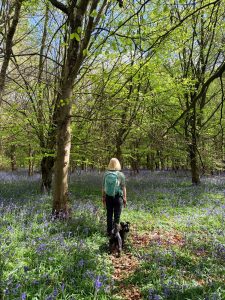 In 2016, Heather was sadly diagnosed with cancer. Walking was an important part of her recovery and in 2017 she challenged herself to walk The Great Wall Of China to raise funds for the Hospice, and to celebrate life. Since then, Heather has also taken part in two Santa Fun Runs with her dog, Sunny, raising valuable funds to support local people.
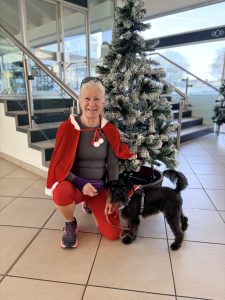
Heather’s connection to the organisation is deeply personal, too. Princess Alice Hospice looked after her sister-in-law, Bhavna, who sadly died in 2017 with a brain tumour, and who received care in her own home. Then, in 2022, a ‘very dear friend and walking buddy died with bowel cancer – she too received palliative care in her own home.’
Over the years, Heather has stayed connected with the Hospice in many different ways. As a long-serving, dedicated Trustee, Heather says she has met ‘some wonderful people, people I would never otherwise have known. These relationships have enriched my life and challenged me to think differently, to take on more responsibility in my retirement.’
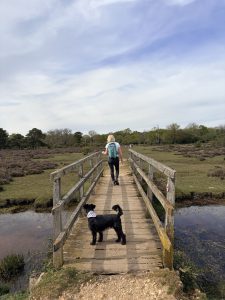
Heather also volunteers as a Compassionate Neighbour which, she says, ‘allows me to offer help and friendship without a professional relationship. It feels good to put some of my life skills to use in a constructive way.’’
Heather’s connections to the Hospice began many years earlier on in her professional life and continue to this day, in her volunteering roles: ‘’All aspects of volunteering give me connection with my community, a community served by Princess Alice Hospice and therefore served by me.’’
Joanna’s story
 ‘’We’re stronger when we’re together, helping each other’’
Originally from Poland, Joanna’s volunteering journey in the UK began with an invitation to step outside the classroom and into the community. Encouraged by her English teacher to volunteer, she found a shop volunteer role at Princess Alice Hospice’s East Twickenham shop, and quickly felt exactly where she needed to be.
From day one, Joanna was “taken aback by how kind people are here” and quickly discovered how busy a charity shop can be! From sorting donations and steaming clothes to learning how to manage the till, no two shifts are the same. “Sally, the shop manager, is so patient with me and trusts me with lots of different things. I never feel judged and I feel very well supported by her and all the other volunteers. I’m very happy in this environment.”
Volunteering has helped Joanna grow in confidence, especially with her English, and has made her feel truly part of the local community. She enjoys chatting with customers, spotting familiar faces around town, and feeling connected to the place she now calls home. “Volunteering has improved my English a lot. I feel more confident to speak, even if I make mistakes, and I’m not worried to ask people to repeat themselves if I haven’t understood correctly. I now feel part of a community where I recognise people on the bus or on the streets, and we always stop and have a little chat, which is so nice.”
Having previously worked as a social worker in Poland, Joanna sees volunteering as a natural fit and an important step towards her goal of becoming a social worker in the UK: “I would like to be a social worker here, so volunteering in a charity shop is good training because of all the people you get exposure to and I want to continue helping people.”
“I am all for helping people, and that’s what working for a charity is. I think our society is built on supporting your community, young, poor, sick… otherwise society will collapse. We’re stronger when we’re together, helping each other, and that’s what makes us rich. A richness found in exchanging ideas, opinions, knowledge and helping one another. It is very precious.”
And finally…would Joanna recommend volunteering? ‘’100% – it changes things in you. If you want to contribute to society, volunteering is the best way to do so. Also that is a great way to get integrated into a new community and establish yourself as a valued member! Also, doing good makes you feel good! ‘’
Shelagh’s story
Before retiring, Shelagh led a busy life working as a Chartered Surveyor, helping to raise her three children and undertaking voluntary work: ‘Volunteering is something I’ve always done, I’ve always wanted to give back. I realised when I retired that I’d need some structure because I do like to be busy, and volunteering definitely gives me that.’
 Since retiring, Shelagh has been a volunteer on the flower team at Princess Alice Hospice and creates floral arrangements from donated flowers for patients and visitors to enjoy: ‘I take flowers into the patients’ rooms and it’s like taking a ray of sunshine in with me, it can be a lovely way to start a conversation with people’. Shelagh then trained to become a Compassionate Neighbour, which coincided with a time when her elderly parents’ care needs were becoming more complex. As an unexpected benefit, Shelagh found the training she’d received helpful when broaching ‘tricky’ conversations with her parents: ‘I was able to talk to them about what the end of their lives might look like, which the training certainly helped with, it allowed me to introduce and talk to them about the future.’
The training sparked conversations about Shelagh’s parents arranging their Wills and then implementing their funeral wishes. Initially, Shelagh’s dad, Fred told her he planned to have a non-attendance funeral and had told her mum, Pat it had all been arranged, despite his children’s reservations.
When Shelagh’s mum, aged 95, sadly died at home in September 2021, shortly after her parents’ 70th wedding anniversary, her dad was able to remain at home with their existing full time carers. Shelagh remains extremely grateful to them for the care and compassion they received. On a walk one day with her father, he told her he had changed his mind and would like a full funeral, knowing the burden of arranging it would no longer fall to his late wife. Shelagh was glad when Fred asked to continue their talk the following morning and is certain these important conversations wouldn’t have happened without her feeling equipped to initiate them through her Compassionate Neighbour training.
Sadly, Fred was diagnosed with bladder cancer on 8 December 2023 and died aged 98, in a hospice, shortly afterwards on 23 December 2023. With the conversations Shelagh had been able to have with her dad, she reflects back that it was ‘a good death’ because he had made his final wishes clear to his family.
After a while, Shelagh was matched with a community member as a Compassionate Neighbour. She enjoyed her weekly visits with her match, an elderly gentleman she visited up until he died: ‘he was such a giggle, he would say to his daughter, ‘I’m still here, darling!’ when she visited. Shelagh has stayed in touch and the two women have met up a few times since.
Shelagh has now been matched with a new community member, who she has been visiting for a year: ‘they’re a lovely couple, he is housebound and she is his carer but also nearly housebound. They have four children and they’ve been married for over 40 years. I love chatting to them both, it’s good for them to have some regular social contact. I really enjoy it, it’s the chance to talk to different people. Having had carer support in my own family, it can be a very valuable medium to have other people helping you communicate your feelings. When my father was unwell, I found I could sometimes talk to his carer about his situation instead of my husband, which relieved the burden on my family.’
To be a Compassionate Neighbour, Shelagh believes a person needs to ‘be a good listener, be non-judgmental; be respectful of privacy and of people’s circumstances. We’re given strict boundaries within the training though, I’m very fortunate to have had that and it’s helped me with my own losses, too. Death and dying isn’t talked about enough though and people sometimes need help to get started.’
Shreya’s story
‘I absolutely loved my time volunteering at Princess Alice Hospice!’
As a 17-year-old pupil at Tiffin School in 2017, Shreya remembers herself as ‘very shy, quiet and reserved, the youngest in the year’. As an A Level student, she hadn’t seriously thought about her career path but says it was the Ward Support Volunteer programme at Princess Alice Hospice that first inspired her to consider Medicine. In January 2025, Shreya took her final exams at Imperial College London and is now a qualified F1 Doctor. She has chosen to focus on oncology and palliative medicine in an ‘elective block’ of her studies and in May this year she returned to Princess Alice Hospice for a 2-week placement. 
‘I loved the nitty gritty of the volunteering programme and it’s what made me want to apply to do Medicine at Imperial. My parents are so grateful to Princess Alice Hospice, it’s had a huge impact on our family. Vanessa (Head of Volunteering at the Hospice) was my Buddy while I was volunteering and she’s a household name in my house! She played a huge role and was so lovely and supportive during my time here.’
In her third year of university, Shreya spent a year focusing on endometrial cancer but also took a paid job in the Princess Alice Hospice shop in Kingston to subsidise her studies, which she remembers fondly.

Back at the Hospice, Shreya has spent time shadowing the Doctors, attending ward rounds and assisting with admissions on the In-Patient Unit. She has also spent time with people in the Wellbeing Centre and visiting people in their own homes with members of the Hospice at Home team. Shreya reflects: ‘the Hospice Doctors are so good, they’ve had years of
experience in previous roles before but are so dedicated to their specialty. People here are so lovely, they say hello and they know who you are. As a student you’re often in the background but I’ve been so involved here, some of the staff even remembered me from my volunteering days!’
Shreya knows that the perception of palliative and end of life care by her peers is that it’s particularly challenging, emotionally. However, she feels this is often because they haven’t had much exposure to it (though Imperial does recognise its value and there is a 2-week module on palliative care in its fifth-year curriculum). Shreya herself finds it ‘incredibly rewarding, you’re helping family members too, it’s the whole team, the whole environment.’
‘The care is exceptional, the consultants are so knowledgeable and have such high standards, they’re on top of the latest research and at the forefront of palliative care.’
Shreya is hopeful her younger sister will be able to join the volunteering programme soon: ‘It gives you really good exposure from a young age, it’s about dealing with people so it gives you life skills that aren’t just specific to healthcare; I think it would benefit people who are creative or considering a career in the Arts, too.’
Bea’s story
‘It’s important to think about the feeling you’ve left them with.’
 Bea is a professional carer supporting adults with learning disabilities, who has also worked in care homes and nursing homes over the years. Despite juggling work and a busy family life, Bea also volunteers as a Compassionate Neighbour at the Hospice and has been matched with a gentleman living with dementia; she has personal experience of supporting her dad who is living with dementia, too.
Several years ago, Bea undertook Dementia Level 2 training at work, which was supplemented by the Compassionate Neighbours training. She has developed a deep understanding of the condition and feels strongly that a carer’s demeanor has a huge impact on the person: ‘they will ask the same question again and again, but you have to answer as if it’s the first time. The person will know by your demeanor if you care about them, so they’ll be upset if you’re upset. You’re not supposed to give them upset, give them the joyful parts of your life.’
There are practical ways that people with dementia can be supported, which Bea has learned over the years: not using white crockery if serving pale foods (which makes the food difficult to see); how signage above doors can help people in their own home, such as ‘toilet’ or ‘kitchen’; how people with dementia will often try to go through doors. If it’s a front door, they can sometimes leave the house but forget how to get back in, so putting a curtain up in front of the front door can help them to walk past it safely and not remember the door being there. Patterned tablecloths can agitate a person, and flooring with patterns can cause anxiety (for example, if a person thinks it is water and becomes scared to tread on it).
Bea has seen the positive impact that memory books can have, as a way of engaging a person with their interests and opening up their world. As a carer, the books can be valuable tools for starting conversations, providing opener question opportunities such as ‘Where was this?’ which can allow the person to go back to that time.
After completing her training, Bea was invited to meet her community member and arranged to visit him and his wife at home. It was a great success and they arranged to meet again the following week, when Bea took her nature-loving match out to a nearby park. Bea describes him as ‘a proper gentleman’ and loves listening to stories about his life, as a former teacher who was fluent in four languages. They often enjoy nature together and he’ll encourage Bea to spot patterns: ‘now, have a look at that cloud.’ They’ve spent time discussing Oliver Twist and have enjoyed feeding the ducks on the river, ice creams out, singing and dancing together in the park. Sometimes they will walk to a bench and he will say, ‘Can we just sit here?’
Bea finds her role as a Compassionate Neighbour fulfilling, describing it as a ‘peaceful, relaxing part of my life. I’m doing it because I want to do it, I’m also getting something back. I don’t walk anywhere, there’s got to be a reason, but (he) likes to walk and because he likes nature and trees, he’ll tell me all about them, I see the birds the way he sees them.’
When Bea spends time with a person with dementia, she always tries to step into their world: ‘People should not forget that the person with dementia still has capacity to make some decisions in their own lives, so it’s important not to take all their choices away. For example, they may want to wear the red scarf not the blue, they may want a coffee not a tea. Leave them with a happy feeling, leave them in a happy place. It’s important to think about the feeling you’ve left them with.’
Bea would recommend being a Compassionate Neighbour to a person with dementia, saying that ‘you need to know you’ll hear things multiple times. You need to know how to step into that person’s world – they’re already on the road, you can make it prettier for them. It could be a grey path, but you can make it a pleasant one with flowers for them to travel on.’
Finally, Bea reflects that ‘you need to be committed to it. I’m so happy with my match, I look forward to seeing him, he smiles all the time and you know you’re doing good.’
Rukhshana’s story
Our volunteer Rukhshana tells us about the rituals around death and dying as a Parsi of Zoroastrian faith:
When Rukhshana’s Father, Dara, was taken ill on holiday in India, all three of his children flew out to see him. Sadly, Dara died 2 weeks after Rukhshana returned to the UK. At that point, Rukhshana was over 6 months pregnant and therefore unable to attend any funeral ceremonies, so she decided to remain at home, but her husband flew back to India.
As a Parsi of Zoroastrian faith, it was important for Dara’s body to be disposed of as quickly as possible. This meant that although family members left on the day he died, the disposal of the body had already taken place by the time they arrived.
Zoroastrians see life as a battle between good and evil, believing that when a person dies their body is no longer needed and the essence of the person, the soul, leaves the body on the fourth day of prayers.
As soon as a person is confirmed dead, Parsi priests arrange for the body to be taken away to the Towers of Silence. Once there, the body is bathed and dressed in white muslin in preparation for the funeral. This is the traditional method of disposal of the body but these facilities are not available throughout India and cremation tends to be the system used by many these days.
The funeral prayers are conducted by the priests in front of the body and then special bearers carry the body up to the Towers of Silence. Traditionally only men followed the priests and the body up to the boundary point but women can now follow if they wish. Everyone walks in pairs, the men holding a handkerchief between them and the women holding onto each other’s saris to protect from evil spirits. Non-Parsis are not allowed to attend but there is an area where they can wait to pay their respects to the family of the deceased. This is the first of four days of prayers and customs.
Once the body is placed into a particular section in the Tower of Silence, it is left open to the elements and vultures are left to consume the flesh. This is the start of the process that allows the dead body to return to nature as simply as possible. More recently, the vulture population has shrunk dramatically and solar panels have been introduced to reduce the time taken for the body to decompose. Over time, other natural elements will decompose the remaining bones and parts of the body. Zoroastrians believe this is the most spiritually pure way of allowing a body to return to nature. 
There are a series of bungalows of different sizes which can be booked for the four days of prayers. Traditionally, family members would sleep and eat together in the bungalow for the four days but nowadays the remaining three days of prayers can be held in a local fire temple if that is more convenient. As a mark of respect meat is not eaten but fish and eggs are. On the fourth day Dhansak, a dish of brown lentils with meat and rice, is prepared by the family. This is the Parsi signature dish but is never served at weddings because of its significance as part of the funeral rituals.
After attending a funeral it is customary to bathe on returning home, to wash away any evil spirits. Some people place a bowl of water by the front door in order to symbolically wash their hands before entering their home. Pregnant and menstruating women do not attend because they are thought to be more vulnerable to evil spirits.
Although Mumbai is an extremely busy and noisy city and the Towers of Silence is in a very central location with tall apartment buildings surrounding it, Rukhshana describes the 54 acres of the site as ‘an oasis of peace surrounded by lush greenery and the sounds of nature. It is a sad, but comforting period with family and friends coming and going.’
On the fourth day the ‘Boi’ ceremony begins at 4am and continues into the new day (the new day starts at 5am rather than midnight). Rukhshana describes it as ’a beautiful ceremony marking the end of one day and the start of a new one as darkness becomes light.’
After this, prayers are said on the tenth day, the first month and the first anniversary. Every year before the New Year starts there are 10 days of prayers when all the deceased are remembered.
Rukhshana’s experience of her mother’s death in the UK was different. In keeping with her faith, Khorshed was determined not to have any trace of her body left behind and she was adamant that she didn’t expect her grandchildren to look after a memorial space after she died. She was cremated at Golders Green Crematorium after a priest conducted Zoroastrian prayers. Friends, family and neighbours of all faiths or none attended. She died in February and her ashes were scattered on the lawn, which Ruchshana recalls as being ‘a colourful carpet of crocuses.’
The Zoroastrian faith is centred around ‘Humata Hukhta Huvarshta’ which translates as Good Thoughts, Good Words, Good Deeds, with the belief that you should live life to the full but give to others less fortunate as well. We are extremely grateful to Rukhshana for her dedicated volunteering with Princess Alice Hospice.
Find out more about Parsi Funerals here: Everything You Should Know About Parsi Funerals – Mitt Arv Blogs
Bal’s story
‘Live your life happily and peacefully in your house.’
Our volunteer Bal tells us about the rituals around death and dying, as the daughter of a Sikh mother:
Bal’s mum, Gurdial Gahunia, was diagnosed with dementia in 2014, having faced significant barriers to receiving a diagnosis. As first-generation Indian immigrants, Bal’s parents moved to Hounslow in the 1960s with their four children. Gurdial was married in India at a young age and received no formal education, remaining unable to read or write for the rest of her life. When Bal was born in England her oldest sister was 20 years older than her and her British upbringing was fundamentally different to her siblings, educationally, socially and culturally. 
In a Sikh family, care for a parent falls traditionally to the son and his wife, who then go on to inherit the parental estate. As Gurdial’s health declined, Bal became more aware of her mother’s needs, while her brother’s own illiteracy made it difficult for him to navigate the British healthcare system and the responsibility fell to Bal and her sisters. Visiting the Memory Clinic, Bal recalls how frightened her mum was by the many questions she was asked, many of which were culturally inappropriate: ‘for example, mum was asked ‘how many times do you think about your husband?’ and what her honeymoon memories were. Mum was 15 when she was married, she was so frightened by the questions that she walked out.’ Bal recalls how her mum was asked to say the alphabet backwards and forwards, when she had no understanding of the English language – ‘that’s when it cemented it in my mind that I’d have to care for her to the end.’
Bal explains that dementia is not generally recognised in India and tends to be seen as mental instability that cannot be medicated or treated in any way. As her mum’s condition declined, Bal decided to become her mum’s primary carer, along with her nephew, who had lived in the family home since childhood. As a single mum to 4 boys, then aged from 16 to 28 years and still living at home, this was a particularly difficult decision for Bal. A roster was drawn up and Bal generally cared for her mum 3-4 evenings and nights after work each week; her nephew did the remaining and they employed private carers during the day. Finding Punjabi speaking carers was challenging, which led to confusion and upset, while some family members still did not understand the extent of the condition. Her sisters also took it in turns to care for their mum and give Bal and her nephew some time to rest.
In July 2023, Gurdial was hospitalised again. Bal was told her mum was going to die and wanted to take her home so she could spend her last days in the comfort and support of her family.
A few days before she died, Gurdial said: ‘open all the windows in the house, people are coming to get me and can’t get in.’ In the Sikh religion, followers believe that somebody who has already died comes to get the person who is dying. 
On Gurdial’s final night, Bal’s older sister put prayers on in the room while Bal liaised with hospital palliative nurses. While caring for her ex-mother-in-law years earlier, Bal had been given advice that she passed on to her nephew: ‘tell Grandma that if someone’s coming to get her it’s OK, she can go, and we will be fine. Keep telling her if she wakes up.’ In recognition of their years of caring, Bal’s older siblings told Bal and her nephew to stand close to Gurdial by the bed, whilst they prayed, Gurdial died peacefully on Sunday morning.
As soon as a Sikh person has died, the process is traditionally taken over by the eldest relatives. The reading of the Guru Granth Sahib (the Sikh Bible) is started in the house or Gurdwara (a Sikh temple) and is read by priests from the temple, in shifts, from beginning to end until the end of the funeral: the speed at which the readings happen depends on the date of the funeral. If the reading is done at home, the Guru Granth Sahib must be positioned so nobody can walk above it. The service begins with Kirtan (hymns) from the Guru Granth Sahib, recited to provide peace and spiritual reflection. For two weeks after the death, it’s traditional for friends and relatives to visit the home and share their own stories of loved ones who have died. No cleaning or cooking should be done, and guests are traditionally only offered tea or water. Traditionally, everybody sits on white sheets on the floor in the home, with men separate to women, though this is less common in modern-day life. As the visitors left Gurdial’s home, Bal was reminded by siblings not to see them out, but to observe the tradition of visitors leaving by themselves. Women tend to wear white or light colours, and their heads are kept covered by white scarves at all times.
Before the funeral, daughters and daughters-in-laws wash the body of their female relative and men wash their male relative, to symbolise purity. The body is first cleansed with yogurt, then washed with soaps or oils. The body can be moisturised with creams or oils before being dressed in brand new clothes. No shoes are put on the feet but can be placed in the coffin. The female’s head is covered with a white scarf and the body is covered by a white sheet up to the neck. The body is placed in a coffin lined with a white sheet of a certain length and an ornate shawl or blanket can be added on top. Close family comes to visit the open coffin and sometimes sprinkle a handful of a blessed cardamon, raisin and almond mixture by the feet and around the body. Bal added petals to her mum’s coffin and her favourite doll, which had brought her comfort during her illness. 
It’s traditional for women to wear white to the funeral and for men to wear suits. Bal’s mum arrived at the temple in a white carriage pulled by horses; Bal and her nephew had picked flowers of every color possible to reflect her mum’s ‘ray of sunshine’ personality.
On the day of the funeral, the coffin goes traditionally from the funeral director to the family home and is taken inside as far as possible, or just outside if not. The priest attends to say Ardas, a prayer asking for divine support and strength for the grieving family and to provide peace and spiritual reflection. Family, friends and neighbours gather to listen. The coffin is carried out by male relatives and taken to the Gurdwara, where it’s positioned head-first towards the Guru Granth Sahib. Prayers are read for the soul to be blessed and for an easy path to the next life. At this point, Guru Granth Sahib readings are still taking place in the Gurdwara, or the person’s home. The coffin is then taken to the crematorium where more prayers are read. Bal’s nephew had prepared a video montage to play, which included a recording of Gurdial saying at the end, as she had often said to everyone, ‘live your life happily and peacefully in your house.’ The traditional closing of the curtain at the end of the funeral was performed by Bal and her siblings. Afterwards, the family traditionally returns to the Gurdwara to hear the final prayers, and a scarf is handed over to the eldest family member, recognising them as head of the family. The family eats food prepared in the temple and the Guru Granth Sahib is covered with an ornate cover to signify the end of the prayers. Bal remains grateful to the ‘amazing’ funeral directors who arranged the flowers and photos in the back garden for when the family returned home.
 The ashes are released in running water as quickly as possible, symbolising the return of the soul to nature. If they’re brought home, they are considered sacred and must stay cleansed. The following year, Bal’s family travelled to India with her mum’s ashes, flying in from different locations on Mother’s Day. For the 9-hour flight and the second internal flight, Bal sat holding the urn, talking to her mum internally in her mind the entire time. It’s traditional that any refreshments bought during this journey should be bought for the deceased relative, too. As Bal left the flights, she left money on the seat behind her and travelled directly to the holy site of Kiratpur Sahib, to perform the traditional ritual of scattering ashes into running water. After washing, Bal’s brother went to register his mum’s death, a manual process where names are handwritten in record books, before the family went to the Gurdwara for prayers and to eat. Afterwards, the family travelled to their late father’s house for an Akand Paath, a 3-day religious prayer ceremony. In the UK, a family could choose to do an Akand Paath or a Sukhmani Sahib Paath, a 1-day religious prayer ceremony each year for 5 or 7 years. Prayers are then said again about two and a half months before the first anniversary of the death.
Back in the UK, Bal chose to observe the first anniversary of her mum’s death with an Akand Paath which consisted of 3 days of Seva, or ‘selfless service’ for others, from 4am on Friday until 3pm on Sunday. In one of her mum’s sari suits and with her siblings, Bal recited and listened to prayers and cooked and served thousands of people with meals at her Gurdwara.
Bal’s parents instilled the importance of humility, being grateful and showing respect to everyone. Since her mum’s death, Bal has volunteered as a Compassionate Neighbour with Princess Alice Hospice; from her community match, she’s learned that ‘you can only do, to the best of your ability in the situation you’re in at the time’ Bal likens this outlook to her own faith in life, believing that she did the best she could for her mum which has helped her navigate her grief and her life now without her mum.
Sharon’s story
Our volunteer, Sharon, tells us about the rituals and customs around death and dying as an Orthodox Jew:
Sharon’s Dad, Jerry, was 95 years old when he died of cancer in November 2019. As a member of an Orthodox Synagogue, he had devoted his later years to charitable causes and was still volunteering at his local dementia clinic two weeks before he died. In preparation for death, Jerry had clear his flat of unnecessary belongings so that Sharon would have less to organise afterwards. As his health declined, he received regular home visits from his local Rabbi. After a short stay in hospital with an infection, Sharon arranged for her father to be moved to a Jewish nursing home for the final few days or weeks of his life.
 When an Orthodox Jew reaches the age of 21, they are expected to join a Synagogue in their own right, and the membership includes a burial plan. Cremation is not an option for Orthodox Jews.
It is customary to be buried within 24 hours, unless an autopsy is required or the person dies abroad. However, as Sharon’s Dad died early on a Friday morning, it was not possible to bury him until the Sunday, with Saturday being the Sabbath. Before the burial, a special priority death certificate must be obtained from the local Registry.
When Sharon arrived at the nursing home on the Friday morning, a Rabbi was already sitting with her Dad, in keeping with the custom of not leaving the body alone at any time. As an only child, Sharon felt comforted that the Jewish Burial Society took over at this point and made all the necessary arrangements for looking after the body up until, and including, the burial.
On the Sunday morning, Sharon and her family travelled to the north London cemetery. The coffin had already been placed in the prayer hall. It’s customary for a close friend or relative to be given the responsibility of tearing a piece of the closest relative’s clothing – in this case, Sharon’s – to show respect and solemnity. Prayers are said by a Rabbi and the plain wooden coffin, unadorned in any way, is wheeled to the grave and placed within it. Close family members are then invited to each shovel some earth onto the coffin. In a moment remembered fondly by Sharon, a friend of her Dad with whom he had played tennis for over 50 years, dropped a tennis ball in with the earth. The simplicity of the ceremony follows the belief that a person should leave the world as they entered it and so the body is left undressed and wrapped in a simple shroud.
Following the funeral, the mourners and close friends and relatives returned to Jerry’s flat, where Sharon was given the traditional ‘meal’ of a boiled egg (for life) and a round roll or bagel, to symbolise continuity of life, no beginning and no end. There is no celebration at this time. On the first evening after the funeral, prayers are said in the evening, usually at the family home. There is an acceptance that nobody is without sin and the Rabbi conducting the prayers will beg forgiveness for any sins the person may have committed.
It’s customary for family and friends to look after the mourners for up to a week after the funeral, visiting them at home to bring food and share stories and memories about the person. During these visits, mourners are expected to sit on low chairs that are provided by the Synagogue, to show respect and humbleness. Sharon loved hearing stories about her Dad from visitors who’d volunteered alongside her Dad at various charitable organisations. As an only child whose mum had died a few years earlier, Sharon felt hugely comforted by the Synagogue community during this time, a feeling that continues to this day.

Between six months and a year after the burial, family and friends are invited to the setting of the gravestone. Prayers are said and, once at the graveside, the Rabbi will read out what is written on the stone. Afterwards, it’s customary for friends and relatives to be invited back to the family home, or to a local venue, with refreshments served as many will have travelled a long way.
After an Orthodox Jew dies, the next child born into the family is given the same Hebrew name as that person, in the belief that they will inherit their good traits and enjoy a long life. A Jewish name is also required for a person to be married in a Jewish Synagogue.
Every year, on the anniversary of a death, a prayer is said in the Synagogue and a 24-hour candle is lit at home as a reminder of the person.
Sharon believes her instinct to volunteer and contribute to her community is very much part of her Orthodox upbringing. Throughout her childhood, she recalls there being annual charitable dinner dances organised by her parents, along with other fundraising events. Sharon is a dedicated gardening and IT volunteer at Princess Alice Hospice, as well as being involved in Holocaust Memorial events each year in her Synagogue. Sharon had a friend who spent her last few weeks of life in the Hospice and was impressed by the end of life care given by the team.
To find out more about Orthodox Judaism, Sharon suggests contacting your local Rabbi.
Patti – Hospice fundraiser and supporter
My association with Princess Alice Hospice started in September 2014 with Dovetail. This is a group which provides support for children and young people who have lost a loved one, as well as parents or carers with children of school age and have lost partners. The reason I volunteered with Dovetail was because my husband, Nigel, died at the Hospice on 9 September 2013. My family and I were very well looked after and I felt I wanted to pay back in some way the caring attention we received as a family. At the same time as volunteering, I also became a member of the Hospice Community Choir.
Cancer has had a big impact on my family. I lost my son at the age of three, and my daughter, Mother, brother and myself have also battled with the disease. Consequently, Cancer Research is also a cause of the utmost importance for me. 
I fundraise for the Hospice as often as I can, my next two events being the two Santa Fun Runs in December and the Christmas Market. By fundraising for the Hospice, it can offer the support which is needed in the community. My daughter is a volunteer at Princess Alice, and my two sons have also participated in events to raise funds for the Hospice. As a family, we are very committed to Princess Alice for the excellent care provided to my husband in 2013.
I have always felt that if one gets help, it is good to give back to that community. I have spent over 45 years volunteering at my children’s schools, my church and the Scouts. In terms of fundraising for the Hospice, I think we have all learned how to be more proactive and well organised before an event. I do not find fundraising challenging. I always try to be prepared for any challenge that is put upon me and do it to the best of my ability. Feedback after every event is not only useful, but necessary.
I am also a Walk and Talk leader at Richmond Park and Painshill Park. I started as a client in November 2013 and, two years later, was asked to become a leader. I would like to say I feel it is one of the best things the Hospice offers bereaved relatives.
In addition to my volunteering and fundraising, I’ve also chosen to leave a gift in my Will to Princess Alice Hospice. It wasn’t something I had initially considered, but when my daughter Kirsty told me she had done so, I immediately knew I wanted to do the same. It brings me great comfort to know that I can continue supporting a place that has meant so much to me and my family. I feel proud knowing that my legacy will help ensure the Hospice can continue serving the local community for many years to come.
My proudest moment was when I was nominated and then received the British Empire Medal for the work I have done for my community. I feel blessed that I have been able to volunteer at Princess Alice Hospice and, in some little way by fundraising, provide bereaved relatives with the support they need to help them come to terms with their loss.
Karen’s story
Karen’s mother, Maureen, was only 49 when she was given a terminal cancer diagnosis and the close-knit, happy family life that Karen had grown up with changed forever. When Maureen came to Princess Alice Hospice in 1986 – not long after the Hospice opened – both she and the family found peace and comfort and Karen’s experience inspired her to devote her life to palliative care.
During the pandemic, Karen started volunteering as one of our Compassionate Neighbours, giving back to the community and to the Hospice that had supported her and her loved ones when they needed it most. Karen returned to the Hospice that holds such powerful memories for her to share her story.
 I grew up in West London with my mum, dad and brother. We were so lucky as a family to love and laugh as we did. Mum had always been fit and healthy and when she started to feel ill the doctor said it was probably a virus. She was diagnosed with ovarian cancer in October 1985 and on my 23rd birthday we learned it had developed into Stage 4 cancer.
My parents were both so young, we were such a strong family unit and we did everything we possibly could to fight this unbearable battle. Mum went downhill rapidly. We did everything we could to care for her. When she decided to stop her treatment, I stayed at home so Dad could go to work and I’d lie in bed next to her, talking, brushing her hair. The first time a Hospice was suggested I had a picture in my head of a dark, dismal place. Mum thought it was best for all of us, but I was terrified and wanted to continue to care for her in our family home. But it became so hard to cope with mum’s physical needs. It’s about dignity – and the Hospice gave that to her.
“Mum looked around and said, ‘Isn’t it beautiful?’”
When the ambulance came to collect Mum, I knew she would never return to our family home. But as soon as she arrived at Princess Alice, she looked around and said, “Isn’t it beautiful? Look at those lovely gardens” and mum knowing that she was somewhere incredible, quietly went into a coma. She died four days later.
Although it was 38 years ago, I can still see every single detail – from the curtains, to the little flowers on mum’s nightie. As she took her last breath, she started to smile and looked so beautiful and so very peaceful. Mum was taken to a special suite in the hospice. I didn’t want to leave the room, because I knew I’d never see her again. But I knew her suffering and her pain was over and she was at last in peace.
Being at Princess Alice again and seeing the blossoms on the trees and the daffodils in the garden, brings it all back. I can see mum as if it were yesterday. It never leaves you and you learn to live life in a different way. Not how you would choose to.
It’s been a long journey and you’re never the same again – but I couldn’t have asked for more wonderful parents and I couldn’t have asked for more care and compassion from Princess Alice Hospice. They wrap you in their arms and make you feel safe. The nurses were like angels.
“The Hospice’s care feels like a giant hug”
It was a very difficult time for our family. My dad’s sister had cancer too and died the same year. I remember saying to myself “We’re going to sink or we’re going to swim. And we had to swim”. Then and there I decided I wanted to devote my life to working in palliative care – and that’s what I’ve done. Dad passed away very suddenly a few years after mum and my brother and I were once again shattered.
But there are always going to be families like ours – time and again, every hour, someone needs a hospice.” I want people to know how important this place is and what the care they give means to families. It’s first class. It’s full of care and compassion and so much kindness. People want that when they’re losing someone. It feels like a giant hug and someone saying “We’ve got you. We’ll look after you.”
If it wasn’t for Princess Alice Hospice, we would have folded as a family. I don’t think we would have coped. It felt as though they were holding us until we were OK to stand on our own two feet. It’s OK to say, “I need help”. Princess Alice was there when we needed them and it will always be so close to our hearts.”
“The Hospice was there when we needed them, so now I find time for them”
My work in palliative care began right after Mum died. I have worked for a children’s hospice for the last 21 years and am so honoured to be a volunteer for Princess Alice. They will always hold a special place in my heart. I’ve seen on so many occasions throughout the the years, how beautiful, caring their service has remained and the lifeline they provide to every person who comes through their doors.
I’m so pleased that Princess Alice Hospice is still going strong. We have to make sure it stays that way. They are reliant on donations with little statutory funding – so we have got to do everything we can. And we need to educate people about the importance of palliative care.
 I decided to become a Compassionate Neighbour because it was the 35th anniversary of Mum. Unbelievably the training was on the day of her anniversary. I remember thinking “This was meant to be”. The first person I visited was a gentleman who’d lost his wife, during the pandemic. I used to make his favourite sandwiches and lemon drizzle cake, and we’d go for a picnic with his dog. He used to say I was the only person who cared. It wasn’t true, but he pushed other people away. It’s not always easy to fit this around my work, but we can all make space and time for the important things.
My story here began 38 years ago and I’ve wanted to tell it for a long time but have never been brave enough. I will be forever grateful that my experience here has helped towards caring for others. The legacy the Hospice left us as a family can never be under-estimated. It is a privilege to be here and to share our journey as a family in the safe knowledge that my mum was cared for with dignity and compassion.
In 2020, Karen was awarded an MBE to mark 35 years in palliative care and continues her plight in ensuring the hospice movement is here now and long into the future.
Antonette, Senior Healthcare Assistant
 Antonette had a successful career in sales and marketing for many years. When she decided to take a step back she begun volunteering as a morning Ward Support Volunteer. After 18 rewarding months a position as a Health Care Assistant came up. Seven years on, with support and training, she is a Senior Health Care Assistant and loves her newfound and unexpected career! Hear her journey.
Mary, Shop Volunteer
Mary’s story: 42 years of volunteering for Princess Alice
 I first started volunteering for the Hospice in 1982, nearly 42 years ago now. When I started, efforts were being made to raise funds to open a hospice in Esher. I belonged to the WI and they were asking for volunteers to help in the first Hospice shop which had opened in Weybridge, to sort through clothes which had been donated. I had never heard of Princess Alice Hospice but thought this was a wonderful idea and I would go into the shop and help on an ad hoc basis whenever I was needed.
When a small Hospice shop opened in Cobham I volunteered as I could walk there. The Cobham shop then moved to its current location in the High Street and, up until 2000 when I suffered an illness, I worked there every Tuesday. From then on, and until this day, I have continued to work at the shop every other Tuesday morning.
I am also very happy to come into the shop and help at other times whenever I am called upon. I absolutely love working there because I enjoy the company of the other volunteers in the shop, meeting and engaging with a cross-section of the public, being helpful and supporting the Hospice at the same time.
I have worked since I was 16 years old as a secretary in different solicitors’ offices and have always liked meeting people. While I retired as a secretary when I was 60 years old, I like to keep myself busy. Working at the Hospice shop brings me alive and I hope to continue there for as long as I am able.
Lauren’s Story
I started volunteering at the Princess Alice Hospice in March 2024 during my gap year, before heading to university. In addition to working at Squires Garden Centre and tutoring GCSE students I found myself with some spare time, so instead of sitting in front of the TV I thought about volunteering.
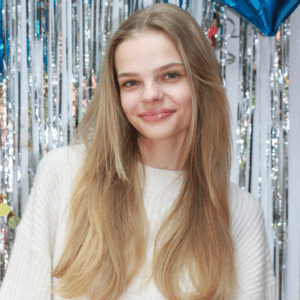 Both my Grandma and Grandad were patients at the Princess Alice over 10 years ago and I can still remember the compassion and kindness the Hospice offered my family during that difficult time. But even before that, my Grandma was a frequent visitor to the Hospice’s day centre. When I decided I wanted to volunteer there was no doubt the Princess Alice was where I wanted to do it.
My role is a Hospice Stories Volunteer meaning I work closely with the Digital Marketing Team. I help with social media posts, podcasts, and digitalising old records, specifically to help celebrate the ‘40 years of volunteering’ campaign. Working alongside the marketing team has been amazing, not only are they all lovely people but I’ve been developing and expanding skills which will be incredibly helpful in future jobs. Even though this is just the start of my volunteering journey I can’t wait to see where it takes me!
Christine’s story
I started working at the Shepperton Hospice shop on the first morning it opened in February 1999. Apart from holidays and COVID, I have been there every Thursday morning since – over 25 years now! There are a number of other ladies who also started in 1999 and who are still working at the shop.
I applied to be a volunteer at the shop having seen an advertisement in the window. I 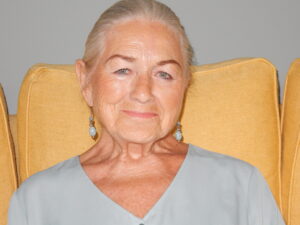 had just retired from my part-time job and I had friends who worked at the Weybridge shop and loved it.
I find my Thursday mornings very rewarding and the fact that, in a small way, I am helping such a special Hospice. I have known so many people who have found peace there. While volunteering I have made so many wonderful friends. The Shepperton shop is a very happy place.
Joanna’s story
I started volunteering at Princess Alice in April 2024, after I attended an Introduction to Volunteering event in January of that year. I retired from my previous job as a Marine Litigator towards the end of 2021 after 30 years working in the City of London.
I have lived in Esher for 17 years and was aware of the Hospice through its shops in Esher High Street and throughout Surrey. Some of my friends had also volunteered at the Hospice.
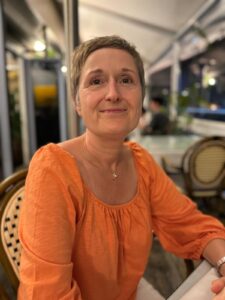
My motivation to volunteer arose following my father’s terminal cancer diagnosis in October 2019. My parents were living in Dorset and my father was cared for by a hospice in Dorchester for the last 5 weeks of his life. My family and I were overwhelmed by the fantastic care he received and all the amazing people who worked there. It was such a bright, uplifting place to be and it helped us cope at a very difficult time.
Having had such a positive experience, and wanting to offer my time after I retired, I looked into volunteering roles at my local hospice, Princess Alice. When I visited for the first time I was immediately struck by the uplifting atmosphere and friendly environment, which mirrored the experience I had had with my father.
I applied for the role of Hospice Stories Volunteer in the Marketing and Communications Department. This involves assisting with social media posts, podcasts and interviews with both staff and volunteers to celebrate 40 years of volunteering at the Hospice. The team is incredibly friendly and makes you feel very welcome. Learning about the dedication of the people who have given so much of their time to the Hospice is very humbling and I hope that this is only the start of my volunteering journey.
Hilary Elfick, former Hospice trustee and volunteer writer
Hilary, a broadcaster, teacher and poet by trade, first heard about plans to build a Hospice in Elmbridge whilst sat in her GP’s waiting room in the early 80s. A leaflet promoting the proposed Hospice caught her eye and she got in contact to find out if she could help in some way. This was the start of her journey as a volunteer for the Hospice.
In no time at all she found herself researching and writing a series of six weekly articles for the local press on what a hospice was and why there was a plan to build one. She was becoming increasingly drawn into the enterprise. ‘I enjoyed working in a team of people with a wide range of skills, and was fascinated by how something as apparently bleak as end of life care could evoke such a positive, even creative, response.’

The articles were published and helped to spread the word about the plans and the need for fundraising to turn them into a reality. Hilary quickly found herself in demand as a speaker and gave talks to a range of bodies throughout the potential catchment area, all the while spreading the word about the planned Hospice. She was fortunate to be able to donate £1,000 herself and become what was known then as a ‘Founder Patron’ – and this meant she was well-placed to encourage others to do the same.
 Hilary continued to volunteer her time, skills and connections to support the Hospice during its early days, for example taking on an active role as part of the committee organising the official opening by The Queen Mother in 1986. She sourced a photographer, wrote speeches for the Queen Mother and the Chairman, and also wrote the commemorative brochure to mark the occasion.
She also set up and trained a team of volunteer tour guides for the new building. ‘It was a joy to watch the community see the fruits of their support and ownership of this new enterprise.’
Hilary became a Trustee of the Hospice and continued in this capacity for 20 years, volunteering her time on several committees. Hilary is pictured below in 1984 – front L-R: Angela Walton, Anne Grainger, Patricia Hayes and back L-R: Trustees Jane Formby, Virgina Waller and Hilary Elfick.
 Once the Hospice was up and running with a full complement of patients, Hilary made a film of the work there and this became a useful tool for continued fundraising for ‘we not only had a building to pay for, but had to staff it and maintain it way into the future. I wanted to show potential sponsors that we actually had a product: the difference we could make.’
Looking back on her time as a volunteer, Hilary is in no doubt that the experience benefited not just the Hospice, but her too, in several ways. ‘I learnt how volunteers could work alongside paid staff, and how everyone, not just employees, were answerable for their conduct and understanding of boundaries.’
Hilary’s time volunteering with Princess Alice Hospice led to a further volunteer role as International Coordinator for Voices for Hospices, which took her to hospices in Australia, New Zealand, Kenya, Uganda, the USA and Canada, where she again put her broadcasting background to good use with radio and television interviews and reports from many a destination, including taking part in lively discussions on end of life care. She spoke live to BBC Radio Two from Nairobi during an event there.
Time spent volunteering has inspired Hilary in other ways too; poetry collections, a play, a novel and other writings have all been enriched by things she has seen, heard, and experienced at hospices. ‘My own beloved father died in the Princess Alice after a seven week stay and it was enlightening to experience its work from the receiving end.’
After some time spent living abroad, Hilary is now back in the UK and living in Cambridge. Although she’s no longer a local, her time as a Princess Alice Hospice volunteer is still close to her heart. She’s delighted that so many volunteers have followed in her footsteps, donating not just their time, but in many cases their skills and expertise, to allow the Hospice to carry on developing and meeting the changing needs of our local community. ‘I came to appreciate that not only did each country have to interpret the idea of hospice to their own specific situation, but that this was true from hospice to hospice. There were seven hospices in Greater Auckland, New Zealand, and each was different, and rightly so. The Princess Alice has its own character to this day and the demography of its volunteers has grown and adapted in its own local way.’
Ingrida’s story
“When I came to the UK from Lithuania in 2013 my English was limited and I had trouble finding work. I decided to volunteer when I saw a leaflet in my local Hospice shop. The staff were always lovely and it’s one of the nicest charity shops I’ve been in, so it was an easy choice.

I loved volunteering so much and continued to do it for almost a year in the shop. I then applied for the supervisor job, and did that for two years, then I was made shop manager for a further two years before moving to the Hospice volunteer team. I am currently the Volunteer Recruitment Manager.
Volunteering is one of the best things I’ve ever done. I found it an extremely rewarding experience, I feel proud I am able to contribute to an amazing cause and it’s provided a lot of new opportunities for me.
Whether it is because you want to find new friends, help your local community, get work experience or even improve your English skills (like me) I would say just do it and see where it will lead you!”
If you are interested in finding out where it could take you, why not come to one of our introduction to volunteering events or explore our current roles.
James’s story

‘Tim told me he’d been diagnosed with oesophageal cancer in November 2021. He hadn’t told me he’d been going for tests before that because he didn’t want to worry me. At that time, he was given six months to live. I just didn’t believe it; I was absolutely devastated.’ Tim died under the care of Princess Alice Hospice on 15 May 2022, aged 67.
James (left) and Tim (right) met at a mutual friend’s party in Guildford back in the 1980s and continued to bump into one another at various occasions over the years, before becoming an established, happy couple for 15 years. They lived a full life and shared a close social circle, enjoying plenty of travel and shared cultural interests. Years later, they went on to marry, after Tim proposed in front of a room full of friends at James’s 60th Birthday party. Just over a year since Tim died, James says, ‘he was my best friend, my world, my everything. Through Tim dying, a part of me has died, too, and I have a very different view of the world now. His death still doesn’t compute.’
James feels fortunate he was able to support Tim through the numerous trips and consultations to the Royal County Hospital in Guildford and describes himself as his husband’s ‘advocate’ during the last month of Tim’s life spent in various hospital wards: ‘my life revolved around talking to doctors, taking food to him, managing friends who wanted to visit when Tim just wasn’t up to seeing them.’
Shortly after his diagnosis, and as an extremely well-regarded Surrey artist, Tim decided to exhibit a final set of his works at Shere Gallery. At this stage, he was feeling relatively well and had been given hope he may have slightly longer to live than first diagnosed. They spent happy times planning short holidays, days out and other ways to enjoy their precious time together, though these were limited due to ongoing chemotherapy treatment. On the exhibition preview night in March, Tim sold over 80% of his works – he was elated despite feeling unwell. The remaining exhibition was a blur of visits to A&E, with James manning the exhibition during the days before visiting Tim in hospital each evening. Numerous tests uncovered nothing while Tim stayed on the cancer ward; in fact, he appeared to be getting slightly better, until one evening he gave James the devastating news that a secondary test had found that cancer had spread aggressively to his liver. The diagnosis was confirmed soon afterwards by a second opinion at the Royal Marsden. James recalls: ‘I really thought we’d turned a corner, that there might be an extra new drug that would help him. We just couldn’t believe it when we were told that there was nothing more that could be done for Tim’.
Back home, the couple decided to plan to visit their house in France over the Easter weekend – Tim was initially reluctant because

of pending chemotherapy appointments, but James was keen for them to go and for Tim to get to see his beloved village where he had spent many hours painting landscapes of the area over many years. While there, Tim’s replacement knee completely seized up one night and a wheelchair was needed to get him back onto the flight home, where he was re-admitted to Royal County Hospital the following morning. An infection in his knee was causing Tim immense pain and required an operation to clean it; as James remembers, ‘I’d flown back to France to close the house up properly and when I got back, he was on a different ward, so unwell and in so much pain after a second, much more serious operation had taken place to clean his knee more thoroughly.’ As Tim’s overall condition worsened and the infection spread through his body, James remembers thinking that he just wanted to get Tim outside, to enjoy some fresh air and see some nature. The focus at this stage was off cancer and on Tim’s knee pain, and James feels now he hadn’t realised the seriousness of Tim’s terminal condition. Despite his large following of Art fans, Tim was a relatively private man and had decided not to share much detail about his illness with friends. As his condition worsened, James’s life revolved around morning visits to the hospital, driving home briefly, then returning to stay with Tim in the evenings and later, to stay overnight in Tim’s room. Eventually Tim was moved back onto the Onslow ward.
As the cancer treatment continued, James feels it would have been helpful for them to have discussed the possibility of Tim dying, which they hadn’t really talked about; James now feels this was ‘a big problem. One of the worst things is that we were never realistic about his death. I’d like to think I supported him fully through his illness and the reality of his passing is awful. I should’ve talked more to Tim about what life would be like for me afterwards, but you just cannot let it be all about you. Any time we tried to, it would end up with me breaking down and he was finding it hard enough to cope with his own death: one person is dying, the other gets to keep on living. We couldn’t bear it, why talk about death when he wanted to talk about life? He always used to say, ‘I’ve got to get on,’ because he was always so busy.’
James feels he was in denial about the severity of the situation: ‘I’ve got my husband in hospital, I know he’s dying but I can’t admit to it.’ James found it upsetting when he would have to remind hospital staff and doctors that he was Tim’s next of kin, his husband. He took it upon himself to keep them both fully updated with the various assessments from different doctors, ensuring that everything that could be done for Tim was being done.
After a period of further deterioration the couple made the joint decision to stop his antibiotic treatment. Prior to this, James had spoken to hospital nurses who had introduced the idea of palliative care; initially, he had felt sure he wanted to take Tim home to die. However, it was a conversation with their mutual friend, Lynne, that made James think a hospice might be better, to allow him to enjoy their time together and not carry the responsibility of caring for him at home fulltime:
‘I just wanted to look after him. If I had another chance, I’d say, ‘my darling, you’re dying, let’s talk about what you want’, but I could never say that to him because I wanted him to live’.
When James began thinking about palliative and end of life care options he took the decision to let Tim die at Princess Alice Hospice: ‘I looked it up and thought, ‘this is the right place.’ He was told that Tim would need to be fit enough to travel by ambulance from the hospital, so he told his husband: ‘I’ve got you the best place, I’ve got you the best hotel, but you need to be well enough tomorrow morning to make the journey there.’
The next day, Tim travelled to Princess Alice Hospice by ambulance and James was there beside him: ‘it was the best feeling ever, I just sat there, and I have never, ever felt so selfless in my whole life. All my thoughts were only for Tim’s care. All I wanted was to get him into a nice comfy bed with a view of trees and nature.’
James remembers a warm reception when they arrived, before Tim was ‘tucked up’ in bed with a drink; he was calm. James stayed in the room with Tim and was able to bring their beloved wire-haired fox terrier, Harry, in for visits: ‘after being in the hospital I was exhausted and on a complete sleep deficit. The bed was more comfortable, and it was quiet, just me and Tim.’
The next day, James was extremely grateful when he was able to organise for Tim to be taken outside into the fresh air – ‘it was very sweet. I wanted to get him outside. My ‘nature boy’, able to finally look onto something green, in nature.’ James recalls the sun was shining and it was a glorious late spring day in May. On the night before Tim died, his bed was lowered to allow James to lie at the same level as his husband. At about 5am, James woke up to the sound of a change in Tim’s breathing. In Tim’s final hour, James talked to him about their time together on their favourite beach in Costa Rica and opened the doors for Tim to hear the early dawn chorus. Inspired by a painting that was hanging in the room, he described the scene on the beach. A little while later, James asked Tim, ‘can you hear me? Darling, I’m going to play you some Chopin.’ Tim died shortly afterwards. James recalls staying in the room, on his own with his husband, lying beside him for a long while.
Since then, James has donated one of Tim’s paintings to the Hospice, in the hope that other families will find them helpful when talking to their loved ones and remembering happier times together. Alongside his work as an event organiser, he has also started to volunteer at the Hospice coffee shop, which he has found comforting: ‘from the outset after Tim died, there’s been something very warm about this place. I was so grateful to get him here to die.’
And what would James say about his experience as a bereaved gay man? He has been surprised by certain friends who have stepped up and really been there for him, yet deeply saddened by a few couples who have not supported him fully through this past year: ‘The best thing someone can say is, ‘how are you doing? How are you doing really?’ You can be who you want to be – tears come and go, nobody can fix this, but invite me round for dinner; please include me in your theatre plans, even if I can’t attend, its nice to be asked. It’s amazing how many people don’t want to be with somebody whose partner has died. It’s made me wonder how I would have been, but it’s amazing how many people don’t want a single person there.’
On Princess Alice Hospice, James says simply: ‘thank God for this place. It was like an oasis in the desert. It allowed me to be with Tim in his final few days and is still a very special refuge.’
Anna, Flower Volunteer
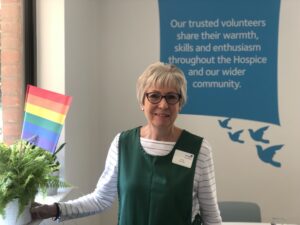 After retiring from a busy career with John Lewis in Kingston, Anna found herself with more free time and was keen to find new activities to fill her weeks. When she discussed her new circumstances with a friend, he told her, ‘there’s always volunteering at Princess Alice Hospice, you belong there!’ Anna wasn’t quite sure why he felt that, but when she visited the website she found a host of volunteering roles available and was advised that she would be well-suited to being a flower volunteer; she applied and began volunteering once a week in 2015.
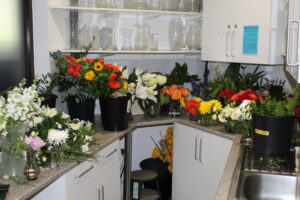 Anna says: ‘I enjoy volunteering here, I had a very active job at John Lewis where I looked after a department. It kept me fit and well, so I knew I wanted to continue doing something else when I retired. My volunteering role at the Hospice means I have met a team of people here, we have regular meetings when we talk about what we do and I enjoy being part of the organisation.’ Anna and her fellow flower volunteers turn a wide range of blooms and foliage – many of which are donated – into beautiful arrangements which can be found around the Hospice, in particular around the In-Patient Unit and the dining room, cafe and reception.
The flower volunteers have met socially on occasions too, enjoying coffee mornings at nearby Garsons Garden Centre; they have found that, as retired people who share a love of flowers, they have plenty to talk about and lots of common interests. It’s also been a chance to learn, too, as one of Anna’s fellow volunteers worked as a florist before retiring.
Anna first became aware of the Hospice when her friend’s partner died here. She was initially slightly nervous to visit, but when she came to the Hospice for the first time she found it to be ‘a charming place. It’s in a very low-lying space with water around it, everything about it is quite delightful.’ Since volunteering here, Anna has enjoyed lunch from the dining room with two friends who visited for a home-cooked meal and have already asked, ‘can we come back and do it again?’
Alongside her volunteering role at Princess Alice Hospice, Anna manages to fit in aqua-aerobics, walking every Saturday, socialising with friends and meeting up with her ex-colleagues each month. We are extremely grateful to our amazing flower volunteers, who create beautiful floral displays for everybody to enjoy in the building.
Charles, Volunteer Gardener
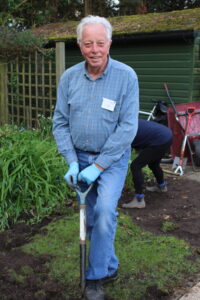 Soon after retiring, I found that I had a lot of time on my hands so looked for something useful to fill the gap. This was partly because my wife has dementia; when she was at home I had lots of things to do looking after her but now that she is in a nursing home my days are relatively empty, hence the need for something.
I have always been busy. I spent many years at sea; I started at training college before joining my first ship in 1969 as a deck cadet. I then took on further training and progressed to chief officer on merchant ships. Later I became a surveyor of ships, which involved a lot of travel, and a lot of studying and research. I’ve been lucky enough to travel the world and being outside and enjoying the fresh air is important to me, I didn’t like being stuck in an office.
I volunteered for and was accepted by the Citizens’ Advice Bureau, but I felt that it was too much of a commitment and there was a great amount of studying to be completed which meant spending a lot of time in an office, which is not for me.
A friend of mine is a volunteer driver for a hospice close to where he lives, and he suggested I contact my local hospice to see if there was anything I could volunteer for there.
I don’t have a connection to the Hospice at all, but I wanted to do something useful that would improve people’s lives. I know that the three hours or so I spend here in the Hospice gardens with the team every week are very much appreciated. I love the process of planting seeds and seeing the plants grow and flourish, and enjoy all aspects of garden maintenance, so gardening works well for me. It is sometimes a very tiring job, but that is OK for me; I walk out of the Hospice feeling I’ve done something good. I sometimes see relatives and residents admiring things which is wonderful. It’s amazing what can be done in a few hours by a small group of dedicated people, as the grounds look fantastic.
When I first came to volunteer at the Hospice, I didn’t really understand how it works; how long people stay and what they came here for, but I went to a very informative induction day at which the procedures, policies and so on were explained to me. I was part of a group of staff and volunteers who were all supported in the same way, and I learned a lot about how the Hospice is organized and run.
I think one of the best things about volunteering here is, and I say this light heartedly, morning coffee! The camaraderie, and of course we celebrate Birthdays – so there is always cake!
Jane, Compassionate Neighbour
 Compassionate Neighbours is a scheme run by Princess Alice Hospice that matches volunteers to local people, providing social and emotional support to those who have a life limiting illness or are experiencing loneliness or social isolation. Our Compassionate Neighbours visit regularly and offer friendship, emotional support and a listening ear. They give people the opportunity to do things they enjoy and help them stay connected to the community, family and friends. Here, Jane shares her experience as a Compassionate Neighbour volunteer with the Hospice:
‘I’m better now you’ve arrived’
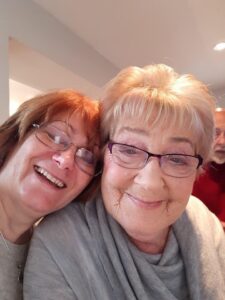 Jane’s mum, Maureen, died in 2018 after spending her final days at a hospice in Dorset. Prior to moving there, Maureen had fundraised for Princess Alice Hospice. Years later, when Maureen became terminally ill, she took Jane and her sister to visit the hospice on the afternoon of her birthday; Jane recalls: ‘we didn’t know what to expect, but we thought it was joyous and positive. Mum said, ‘I want to die here, not at home if possible.’’ Maureen was later admitted to the hospice and Jane and her sister visited every day: ‘There, watching, you became part of it. My sister couldn’t believe how caring the hospice was, there was nothing they wouldn’t do. Nothing was too much trouble, we were so grateful and that’s what made me think about Princess Alice Hospice again.’
Jane’s career in educational special needs and disabilities spanned 40 years and when she retired in 2021, she was determined to spend her time volunteering while she was still fit and well; it was Princess Alice Hospice that benefitted from her time and she completed two Saturday training sessions to become a Compassionate Neighbour, meeting her first match in March 2022.
That match was a lady in her nineties called Jean, who had been referred to Princess Alice Hospice by her GP. Jane describes her as ‘such a special person, it would be naïve to think everyone would be like Jean.’ The first time they met, Jane remembers ‘the biggest smile, I was welcomed like a guest and there were china teacups and biscuits on a tray.’ Jean would meet Jane at the same time every week, generally wearing a brightly coloured, flowery top. Early on, they talked about holidays they’d both enjoyed in the west country; the following week, Jane took scones with jam and cream on her visit and remembers that ‘we scoffed the lot, we loved it!’ After that same visit, Jean had remembered Jane telling her how her mum had made her green jelly on holiday; for the next visit, Jean had asked her son to buy some and made it in small pots for them to enjoy, too.
Both women grew up in the same part of London and spent hours talking ‘non-stop’ about their childhoods and families. Jane recalls when Jean was invited to a friend’s 100th Birthday tea at a local cafe and she insisted on driving her there. The following week Jean told her, ‘Don’t say no, but you’re coming with me!’ They had a lovely time and Jean later told Jane that one of the other guests had asked, ‘Where did you get her? I want one!’
Prior to moving to a care home, Jean had been receiving care at home from Princess Alice Hospice community nurses, which continued in the care home until she died. Jane recalls her saying, ‘I don’t want to be dying, I just want to live,’ which Jane credits to the positivity and compassionate care given by the Hospice; when a community nurse visited, Jane recalls how he took time to reassure and talk to Jean’s visiting granddaughter and son, too. Jane was touched to be invited to Jean’s funeral by her family last year: ‘she was such a joyful person to be around, a real inspiration, and I received much more than I gave her, I’m sure.”
Jane was keen to continue volunteering as a Compassionate Neighbour and she and Dennis were matched after his GP contacted Princess Alice Hospice to discuss support options for him. A series of falls at his home in Chessington has left him housebound because the access to his house and the back garden requires him to navigate steep stone steps.
As Jane explains, ‘Dennis is in his late eighties and housebound. Each day, he gets up about 5.30am – he’s OK in the afternoons because he watches television before he goes to bed at 7pm, but in the mornings he gets lonely.’
Dennis has three grown-up children with busy work commitments and children of their own, and although they visit frequently, they were concerned he was getting lonely and frustrated after becoming housebound and no longer able to potter outside in his beloved garden.
On Jane’s first visit, Dennis’s daughter was there and explained how Jane ‘was very honoured, he’s put a shirt and tie on for you!’ Dennis told Jane he couldn’t believe she had chosen to give her time in this way – Jane says he was almost ‘incredulous’ that this can happen and was ‘very, very grateful.’ When Jane and Dennis discussed fixing a set time in the week for the visit, Jane remembers his reply: ‘I don’t care, whatever day you can give suits me, my dear.’ Each week he continues to greet Jane at the door with his stick and when she asks how he is, he replies, ‘I’m better now you’ve arrived.’
Jane says it’s astonishing how quickly she’s been able to get to know Dennis, who shares a love of family and local history. Dennis was particularly proud to share a story of how he alerted gas workers to a disused air raid shelter that was hidden underground in the area they were due to start works on, which resulted in an article in the local magazine.
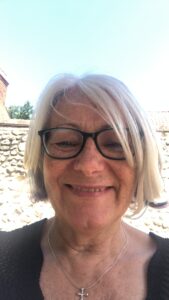 Jane is clearly passionate about the Compassionate Neighbour scheme, saying ‘how awful it must be not to look forward to anything, to be sat on your own. For you, it was only two hours, but for that person it might be the only break in their week.’ Jane believes that ‘everyone’s entitled to live a good life to the end. I hope Dennis will be able to get out again, and then we can go out and walk to the local bench with a bag of chips. We can go in my car to the local museum, which is in the old hospital building where his late wife worked as an occupational therapist.’
Jane would highly recommend being a Compassionate Neighbour to others, saying: ‘I need to be giving back. Princess Alice Hospice is helping me by allowing me to do that. I help Dennis by being part of a recognised scheme, which people can trust and I think their families are very comfortable, too, because they know you’re coming from such a trustworthy place. It’s helped me, it’s become my new lanyard to replace my working lanyard. You’re privileged to be part of someone’s life; it won’t last forever, but that’s part of life.’
Fabienne
I completed 3 weeks of work experience at Princess Alice Hospice, within the marketing department. The Hospice was an extremely welcoming, caring and enjoyable environment to work in. Some of the tasks I completed during this time included using software to create social media posts, shop visits to create content, learning about website changes and attending staff meetings. We also worked together with other departments to develop booklets to be used within the Wellbeing Centre. I enjoyed being involved in all the tasks which improved my confidence over the few weeks at the Hospice. I have learnt lots of skills during my time here which I hope to carry forward with me in my future career journey.
Vermilla, Shop Volunteer
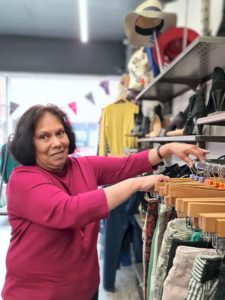 “I began volunteering at the Princess Alice Hospice shop in Twickenham about five years ago. I was looking for a new challenge after a career in a large media company, where I worked in a variety of departments, including accounts and production, before becoming an office manager for almost six years. I was made redundant and decided to use part of my financial package to go on holiday, which is when I took the decision that I would retire from work. Soon afterwards, I began helping neighbours with their shopping and I worked in another charity shop for a while, too.
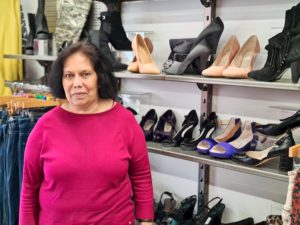 After a while, I began volunteering at Princess Alice Hospice and realised it was a great way to meet new people, to gain different perspectives on life and to talk to people in my area – some local residents come into the shop to chat to us and share what they’re going through, which can be very rewarding when you know that they’re lonely and it’s helped them to talk. I was keen to learn about all aspects of the shop and it was great to know that people were motivated to donate items because of the cause – the Hospice is so well respected in the community. So often I hear stories from customers about the care their friends or families have received. Recently a lady told me that her mum was cared for at the Hospice and she was really keen to come and buy something in our shop to support it.
I tend to volunteer my time on Mondays, but I’m happy to help at other times if I’m needed, I always try to say yes. I help to steam clothes that have been donated, help customers at the till and sort out other donations that come in. I always say that if I was to win the Lottery I would give money to Princess Alice Hospice, I really enjoy my time helping in the shop.”
Sheila, Retail Volunteer
 As a resident of the Borough of Richmond upon Thames for over 40 years, Sheila has always been aware of Princess Alice Hospice – ‘living in the borough, you can’t help but know about it’ – but it was the care provided to a close family friend by the Hospice that demonstrated the true value of their services to her.
For the last 9 years, Sheila and her husband have lived in Twickenham. Over the years, they have travelled abroad extensively with their work, raised three daughters, and now have grandchildren living close by and in Singapore. Five years ago, Sheila’s husband was diagnosed with a brain tumour, for which he was treated successfully. Around the same time, the consultancy firm Sheila was working for was bought out and the culture changed dramatically; it was also around this time that the couple became grandparents. At 64 years old, Sheila felt these significant life events were a sign that it the right time to retire and begin focusing on different things.
Retirement soon became busy with activities including Bridge games, acting as PA to her husband, swimming and spending time with her first grandchild. One day Sheila chatted to a neighbour who, at that time, was managing the Princess Alice Hospice shop in Twickenham. Sheila was keen to forge closer links in her local community and began volunteering at the shop, starting by steaming donated items of clothing in the back room. Sadly, Sheila’s mother died shortly after she began the role and she took some time off before returning – today she is proud to have earnt her 5-year volunteering badge and is quickly heading towards 10 years!
Fast forward to 2022 and the Twickenham shop has moved to a more prominent location on the high street. Sheila says:
‘I love interacting with the public, I don’t want to spend my time working in an office because I did that for so many years. I’ve been told I have a good eye and I love the way the shop managers take such pride in their work; they do colour banding so that clothes are grouped by shades of colour and it’s really eye catching when customers walk in. I get involved with all aspects of the shop – sometimes I’m asked to look up a donated item on the iPad so I spend time researching similar things to find out what we should charge for it.’
Attention to detail is a prerequisite of the volunteering role – if a 100-piece jigsaw is donated, then Sheila will need to count and check that all 100 pieces are in the box, to ensure the items sold are of a consistently high quality. Sheila recalls one customer mistaking the shop for a new clothes boutique due to the beautiful range of items on offer, asking if she had a particular dress in a size 12!
It’s clear that Sheila takes great pride in the role and she enjoys spreading the word about the work of Princess Alice Hospice within her local community. As well as raising vital funds for the Hospice services, the shops perform other important functions in their local areas, too: some customers are lonely and Sheila recognises that chatting to her might be the only time they’re able to engage in conversation that day.
When asked what the impact of COVID-19 has been, Sheila says she was keen to return to the shop once it reopened after the lockdowns; after two vaccinations and a booster, she resumed her role and adhered to the safety measures that were put in place, some of which are still in place now. The biggest change Sheila has noticed is the move away from cash to contactless payments from customers, a change that is here to stay.
Sheila’s advice to anybody thinking of volunteering in their local Princess Alice Hospice shop would be:
‘‘I do one morning a week and I’ve received hundreds of compliments about how beautiful we make the shop. I love being part of the team and enjoy the team spirit we have, it’s great that we get to spend time with people of all ages. Of all charities I support, it’s the one I choose give my time to, because I get so much out of it. I’m very, very lucky to be fit and active, and I love to be out and about. All of us in the Twickenham shop volunteer for just half a day and there’s plenty of flexibility. I’d say to anybody considering volunteering to give it a go. It’s not a huge commitment of your time and Princess Alice Hospice will be so grateful. I had to be trained on using the till but I was given the time I needed, and if you have a particular interest, say in music or books, you can often weave that into your role. Go for it!’’
Anne, Compassionate Neighbour
Compassionate Neighbour, Anne, originally qualified as a midwife and has been nursing for over 40 years, including a period of time spent working as a bank nurse at Princess Alice Hospice when her children were younger. For the last 10 years, she has worked in a safeguarding role for young people at Kingston Hospital. In 2018, and with her own children now grown up, Anne was keen to give a few hours a week to a volunteering role, which is how she found out about the Compassionate Neighbour scheme run by the Hospice; drawn to the idea of giving something back to her community, Anne decided to sign up for the weekend of training, which included role-playing many different scenarios to prepare her and others for situations that Compassionate Neighbours might come across, which Anne found both useful and enjoyable. Soon after the training, Anne was matched with a lady called Stella, who had recently been referred to the scheme; Stella was 98 years old, bed bound and living by herself, with the help of carers, in a maisonette in Surbiton.
 At their first meeting at Stella’s home, Anne felt very lucky that she had been matched with this extremely independent lady and enjoyed her visits from the outset. They soon settled into a comfortable routine which continues to this day: Anne tends to pop round one evening in the week and on Saturdays, having done some shopping for Stella and taking a few of her favourite things: the Daily Mail newspaper and tv guide, a packet of scones and some lemon drizzle cake. As Anne says, ‘it’s been a real eye opener to me, Stella is happy with what she has – her TV, her cakes and a warm room, she’s happy to have a big window to look out of and watch the clouds.’ The pair have spent time talking about Stella’s memories of the Great War, and she’s entertained Anne with her stories of D-Day celebrations on Wimbledon Common. Stella used to have dogs and is a real animal lover, so she loves it when Anne’s dog, Betty, comes to visit and she’s able to feed him treats. Other members of Anne’s family have enjoyed getting to know Stella, too, and if Anne can’t make her weekly visits her daughter, Abby, is happy to pop along with her own dog, Betty’s brother, Sid: ‘Stella likes to have young people around her and she adores Abi,’ says Anne, ‘her eyes light up when she sees her.’
 What has the impact of being a Compassionate Neighbour been on Anne’s own life? As she herself says, ‘I feel very lucky I was matched with Stella. She’s never overstepped the mark with what she expects from me. I’m not trying to replace a family member and we’re not ‘gushy’ or ‘huggy’ with one another, but she knows she can rely on me and we enjoy one another’s company. My sister, Liz, has also met her and we’ve said that with our own mum no longer being around, Stella fills a bit of a void and I’m doing what I’d be doing for her if she was still alive – getting her some shopping, checking up on her.’
 What would Anne’s advice be to anybody who may be considering becoming a Compassionate Neighbour? ‘I think it’s really important to remember you’re in that person’s home. They often won’t see many other people at all and so you have to know how long you should stay. It can be exhausting for them, so 15 minutes of good quality time is better than staying for hours. It’s a two-way thing as well, if it becomes a chore and you don’t look forward to seeing the person then it’s not going to work because they will pick up on that.’ Anne feels very lucky to have been matched with Stella, there are elements of her own personality that she recognises in her and it’s clear they have become close. Anne will be retiring from nursing soon and is very proud that Abby has just qualified as a nurse and is also now working at Kingston Hospital. But Anne will definitely continue her twice-weekly visits to Stella, accompanied by Betty: ‘I saw straightaway that Stella is her own person, she doesn’t always want a lot of conversation but she’s very happy to sit with Sid up on her bed. A while ago she had to go to a nursing home, which she really didn’t enjoy because she values her independence. She was so happy to get back to her cosy flat, which she has just the way she wants it; she’s got her boxes with things in and her lamp with a low bulb, but it’s just how she likes it.’ It’s clear that Anne has a huge impact on Stella’s life, too, and helps her to continue living in a way that suits her.
Thinking about volunteering? Find out more about our Compassionate Neighbour role or other volunteering roles.
Lucinda, Planning Ahead Volunteer and Compassionate Neighbour
 I started volunteering at Princess Alice Hospice after taking a career break to raise my children. Previously, I had worked in government social housing for the elderly for over 10 years, then volunteered with Age UK providing information and advice; supporting patients at Epsom Hospital and advising on services available in their local community.
When it came to volunteering at the Hospice, I was looking for a community-based role and initially enquired about becoming a Compassionate Neighbour back in 2019, but the Planning Ahead role was a better fit with my skills. As a Planning Ahead volunteer, I help a patient or community member record their wishes and needs regarding their future and their end-of-life plans. It’s about listening, talking, and giving information to facilitate making informed choices. The importance of the role is also that it reassures the person that these decisions can be talked about with family or close friends, which is something we encourage. This aspect of the role is very rewarding, although you don’t always get to see the result. It has helped me have these conversations with my own family, too.
I had no prior connection to the Hospice before I began volunteering here, but my own experience of bereavement has shown me the importance of family members knowing what someone would want. This wasn’t always the case and made a stressful time even more difficult. If there had been a Planning Ahead process, this would have given us more direction as to what they wanted.
You need some resilience to do this role. This helps because when starting along this journey, a person can experience a range of emotions including anger and vulnerability. You also need to be impartial and not influence them at all and keep in mind that you are there to help and facilitate the process, but the decisions are theirs. Their funeral wishes or care choices might not be the same as yours and it is important to respect that.
Since starting back in 2019, the role of a volunteer has changed due to the Covid-19 pandemic and the restrictions of not being able to meet people face-to-face. However, I have had telephone calls instead and this has worked well. In 2020, I also decided to become a Compassionate Neighbour too (the role I originally applied for back in 2019) and this is about providing a listening ear and identifying how they a person can improve their life by finding activities they may enjoy, as well as finding purpose in their life.
I enjoy volunteering at Princess Alice Hospice as it offers flexibility, and the training and support is excellent. That’s why I’m now doing two roles! If anyone was to ask me about volunteering at the Hospice, I would say ‘do it, and don’t be put off by the word ‘hospice’’. It is supporting people towards the end of their lives but is such a positive place. We help give control to the person, giving them confidence together with the supportive environment at Princess Alice. It is very rewarding knowing you have made a difference to someone’s life.
Jenny – Bereavement Support Volunteer

Jenny fits in her role as bereavement support volunteer alongside a very busy life in retirement and has found not only deep satisfaction from the work, but enduring friendships as well.
Jenny has lived in Shepperton for about six years – where she moved to be closer to her two sons and their families, after her husband, Jim, died in 2013. Married for 50 years, they had been enjoying retirement in Norfolk for 20 years. After her husband’s death, Jenny’s brother David also died – which she said was “very hard”.
“I felt the need to make a new life, and at the same time be a little closer to my sons without being a burden to them,” she said. “They are both around an hour away which works well for us all.”
Settling in to her life in Surrey, she met someone who already volunteered at the Hospice – and who suggested she might be interested in a bereavement support role.
The main aim of the role is to provide bereavement support to bereaved families and friends after the death of patients who have been under the care of the hospice.
Jenny’s varied career in performing arts and then teaching and as a social services children’s adviser, had honed her people skills and provided experience that would prove invaluable in her volunteering role.
She said: “In my social services job – as under-eights adviser to nurseries and childminders – it was essential to be non-judgemental, a skill that is sometimes needed when working with clients.”
She went along to an open evening at the Hospice: “I was very impressed by the whole atmosphere.
“Having in the past been involved in all sorts of events, mainly to do with my children’s schools, Scouts and so on, I felt that a change of direction would be interesting and rewarding.”
Jenny’s initial work was as a telephone volunteer – which she started after a short training period.
“You do this from home, at a time to suit yourself,” she said – which fitted in very well with her other regular activities. She’s a keen dog walker and bridge player, also finding time to fit in a psychology course, amateur theatre and travelling.
“Generally we were asked to contact around 10 clients a month and feedback was given at a monthly meeting,” she said. “This was a gentle start over a period of about a year to what became a pathway to the fascinating, sometimes challenging route via the more intensive training to become a member of the 1-1 support team.”
She felt ready to move on to another role – bereavement support volunteer, based at the Hospice itself in Esher.
“The training took three months – a whole day each week with an obligation to write quite an in depth journal at the end of each session,” she said. “It was necessary to have an interview before being accepted on to the course, plus one at the end before I was accepted on to the team.
“The course was intensive and challenging, but hugely stimulating and enjoyable .We got to know each other in considerable depth. Friendships were made, many of which continue today.”
She finds the supporting structure behind the role very reassuring.
“We get huge support, advice when it’s needed and ongoing training, which is really useful.
“As volunteers we are very well looked after and are made to feel valued,” she said.
Jenny said that, as bereavement support volunteers are expected to support a minimum of three people at a time, life can get busy; however appointments are made at mutually agreeable times, so it is possible to work round other commitments.
“We see people in the early stages of bereavement, sometimes overwhelmed by their grief – or maybe taking on too much on a daily basis to cover or hide their pain,” she said.
“It is extremely rewarding when a client begins to see a chink of light in their darkness; also witnessing their sense of relief that much of what they are experiencing is normal.
“We cannot offer solutions or wave a magic wand, but we can help them find their own way down what can be a very bumpy road.”
There are challenges as a 1-1 supporter. Some families have very complicated histories and ongoing issues, and sometimes clients wander away from the central issue of their particular loss.
Jenny said: “It is therefore important to keep them focussed.
“While empathising with clients it can never be about us.
“Over a period of 12 sessions we are privy to very private and personal information about people, but we have to maintain boundaries. This can occasionally be difficult.”
She said clients appreciate the opportunity to sit in a quiet room with someone who is completely impartial and non-judgemental – that anything they say is totally confidential.
“They come on a weekly basis if possible and they appreciate that it is their time and that they can be completely open and honest about their feelings,” she said
Bereavement support volunteers are expected to attend regular remembrance meetings where relatives can look at their loved one’s name in the Book of Remembrance. Jenny does every other month.
She’s also looking forward to an additional role at the Hospice; accompanying a new Pets As Therapy dog, which she already looks after regularly and which has been assessed and accepted as suitable.
For more information about the volunteering roles in Bereavement Support at Princess Alice Hospice, contact the Volunteering team on 01372 461856 or email [email protected]


