How Princess Alice Hospice started
The Hospice movement
The modern-day hospice movement came into being in 1967 when Dame Cicely Saunders founded St Christopher’s House in London. However, end of life care dates back much further. In our own area, Esher has cared for its poor and sick inhabitants since the middle ages. Records show that ‘Sandon Priory’ was involved with the care of the sick and the poor of the parish, and is believed to have stood on the present site of Sandown Racecourse. In 1436 the Bishop of Winchester united Sandon Priory with St. Thomas the Martyr and this foundation is now known as St. Thomas’ Hospital.
From idea to reality
Moving forward to the late 1970s, Geoffrey Gardner, a retired businessman and a Reader at Christ Church, Esher, was making monthly visits to Trinity Hospice, Clapham, where he helped both as a volunteer and in fundraising. In 1980 Geoffrey went to see his friends Edwin and Kathleen Stevens to discuss the subject of fundraising for Trinity. Edwin Stevens remarked that Clapham was some distance from Esher and maybe a hospice was needed just as much here. He said, “If you’ll do the work, I’ll help financially.”
For the next eighteen months, Geoffrey Gardner “did the work”. With the help of a number of his friends, and with considerable personal initiative, he asked the questions: possible sites, suitable architects, cost of building, staffing and maintenance. But most of all – were the terminally ill in the local area sufficiently provided for, or could a hospice make a specific and crucial contribution? The need was evident.
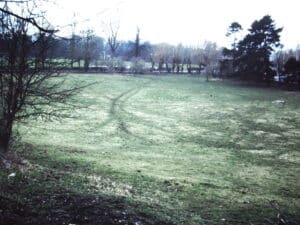 In 1980, Geoffrey Gardner asked for the assistance of the Council in finding a suitable site, and they suggested the site on the corner of Lammas Lane and West End Lane. This land belonged to the Surrey County Council but they no longer needed it, and the hospice trustees acquired this beautiful site for £78,000 in August 1981, financed by Edwin Stevens’ first generous donation of £100,000.
Geoffrey was not acting alone, but already co-opting certain key people. He set up a Trust, and recruited the first trustees, Dr. Thelma Bates, an Esher resident but also a world authority on Terminal Care; Peter Munday, an Esher solicitor with considerable local knowledge who drew up the Trust Deed (January 1981) for what was then known as “The Elmbridge Hospice Charitable Trust”; Patrick Townend, a friend from Christ Church who brought very sound accounting skill and experience; and Virginia Waller, a well-known and respected local Councillor.
The Trust completed the research, instructed the architect, chose the builders, found the money, appointed the principal officers and saw the first patients in – all within four years, during one of the worst recessions of the century.
The fundraising effort
Soon local fundraising under Virginia Waller was well under way, and Virginia’s Vice Chairman on the Appeal Committee, Jane Formby, joined the Trust. She was closely followed by Hilary Elfick, who was responsible for much of the Public Information programme. The building of The Princess Alice Hospice was the most successful regional capital appeal of its time.
Geoffrey Gardner asked Virginia Waller, by then Mayor of Elmbridge, if she would have a Mayoral Appeal for funds to build the hospice – which she did, starting in November 1981.
The response to the Appeal was immediate and widespread.
From that time onwards, in a steadily expanding area which was to encompass all the ground the Hospice services would reach, branch committees were formed – under the main Appeal Committee which was chaired, led and inspired by Virginia Waller and Jane Formby.
Between them these committees generated the response which produced over one third of all the money needed to build and equip the Hospice: an unprecedented proportion for a project of this kind. It was a most extraordinarily successful operation.
The Appeal Committee had two principal aims: to run events which would raise hard cash, and to run a public information programme about the specific contribution the hospice could make to the community. Hilary Elfick, a local writer, researched and wrote a series of newspaper articles on the Hospice Movement in general and the Elmbridge Hospice in particular, both to stimulate interest amongst the general public and to help the members of the branch committees to have reliable facts at their fingertips.
 It would be quite impossible to list every event or initiative of those early years. From the very outset Virginia Waller used the contacts she made as Mayor of Elmbridge to encourage the neighbouring Boroughs in the catchment area to involve themselves in fundraising. There were balls, raffles (including one to win a brand new car), receptions, lunches, auctions, fashion shows, concerts, coffee mornings and fetes; runs, swims, cycles, golf days, parachute jumps, squash marathons and a boxing night. Local GPs, Round Tables, Rotary Clubs, businesses, local churches and schools and other organisations got involved.
The Appeal coincided with the gradual disappearance of the “tiddler” – the 1/2p piece – and a local newspaper ran a tiddler collection which was extraordinarily successful. Over £2,000 worth came in, in a matter of weeks, and seemed to go on arriving until those involved could hardly believe there was a tiddler left in the county.
Why Princess Alice?
 For the first eighteen months, 1981-83, the new Hospice to be built in Esher was described as ‘The Elmbridge Hospice’. It did, however, seem to be inappropriate as the permanent name. Elmbridge had a distinct geographical boundary and the Hospice would bring care to a much wider area.
When the building programme was about to start, there was increasing public knowledge of the project and the way we would be bringing care to this area. It seemed right, therefore, that we should give the Hospice its permanent name.
The trustees were delighted to announce in March 1984 that from then onwards the Hospice known as The Elmbridge Hospice would be called ‘The Princess Alice Hospice’.
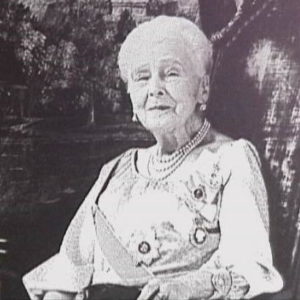 Princess Alice, Countess of Athlone, died in 1981, the year in which the idea for a local hospice first arose and grew. Everything known about her then suggested that she would have most warmly encouraged the scheme.
Princess Alice was the last surviving granddaughter of Queen Victoria. As a young child she lived at nearby Claremont and visited Esher village often. There were innumerable local connections with the family and Princess Alice’s daughter, Lady May Abel Smith gave her kind permission for the hospice to be named after her mother.
Alice’s father, Prince Leopold, was the Queen’s youngest son, and the most delicate. He was a haemophiliac, and his daughter Alice was to become a carrier of the disease. Both her father and her elder son, Rupert, died in their twenties. Her other son, Maurice, died at only 6 months.
The presence of this tragedy in her life seems to have given Princess Alice, by contrast, a most remarkable vitality. She had an energetic unsentimental compassion and a great ability to make friends and retain the affection of relations. Her impish warmth invariably enlivened official speeches. “Human beings are the most fascinating study in the world,” she said in 1966. “Besides, I like them.”
The Hospice takes shape
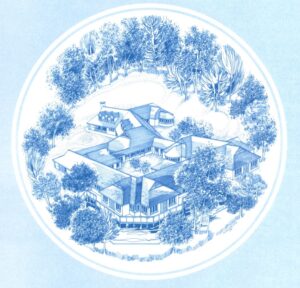
 Building work was underway by 1984. On 21 June that year, the work paused briefly to mark the occasion. Anne Grainger, granddaughter of Princess Alice, made her first visit to the site and planted a tree. Fast forward to February 1985 and Anne returned to join Geoffrey Gardner in laying the last brick – the ‘topping out’ of the building, which was handed over to the trustees later that year. The Hospice opened to patients in November 1985 with all the costs of the building and furnishing met. At the time, the building incorporated 5 single bedrooms and 4 five-bedded wards, as well as a family room, plus a range of other facilities.
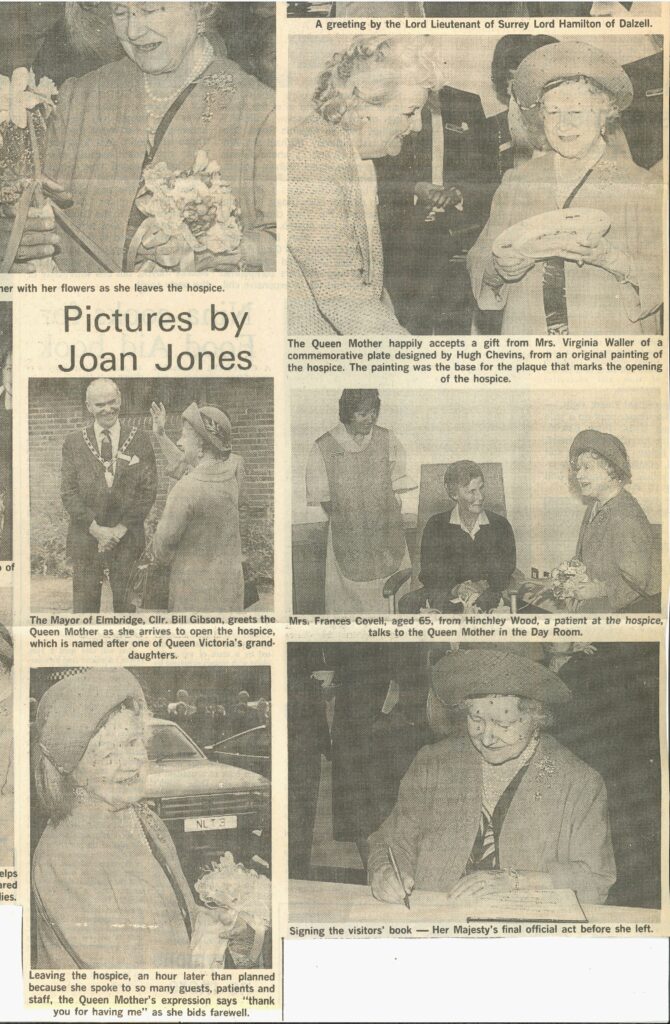
For five weeks during August and September 1985, the building and gardens were opened to the public. Over 3000 people came and were shown around. In March 1986, the official opening took place with a visit from Her Majesty Queen Elizabeth the Queen Mother.